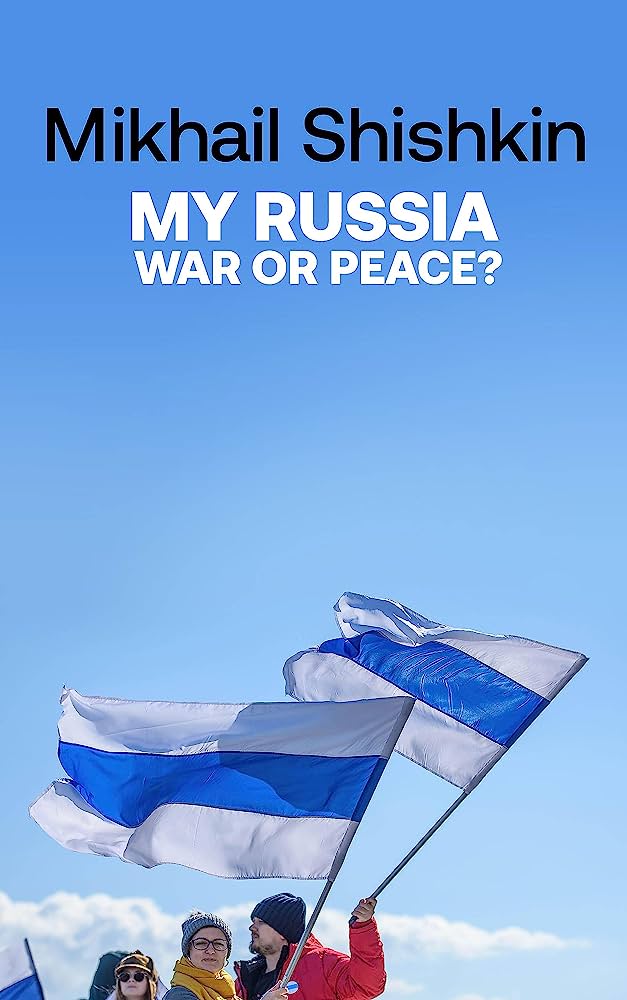
My Russia in other Languages
“In his timely new book, Mikhail Shishkin, argues that Russia is not a ‘riddle wrapped in a mystery inside an enigma’: we just don’t know enough about it. So what is the real story behind Putin’s autocratic regime and its invasion of Ukraine?
In My Russia: War or Peace? Shishkin traces the roots of Russia’s problems, from the ‘Kievan Rus’ via the Grand Duchy of Moscow, empire, revolution and Cold War, to the now thirty-year-old Russian Federation. He explores the uneasy relationship between state and citizens, explains Russian attitudes to people’s rights and democracy, and proposes that there are really two Russian peoples: the disillusioned and disaffected, who suffer from ‘slave mentality’, and those who embrace ‘European’ values and try to stand up to oppression.
Both deeply personal and taking a broader historical view, My Russia is a passionate, eye-opening account of a state entangled in a complex and bloody past, as well as a love letter to a conflicted country. Will Russia continue its vicious circle of upheaval and autocracy, or will its people find a way out of history – and how can we help?”
Reviews and Interviews
Mikhail Shishkin: “The main enemy of Russian culture is the Russian regime”
By Andrew Anthony
“The Observer”, 2.04.2023
Mikhail Shishkin: Putin’s regime doesn’t need culture at all now
By Marc Bennetts
“The Times”, April 10, 2023
‘War or Peace?’: Writer Mikhail Shishkin shatters the Russian lie
By Florent Georgesco
“Le Monde”, June 17, 2023
By Roger Ratcliffe
“Big Issue North”, London, NO.1476, 27 March – 2 April 2023
By JP O’Malley. Index on Censorship, Volume 52, Issue 2., July 2023
Mikhail Shishkin, My Russia: War Or Peace?
An interview with Mikhail Shishkin
By Daniel Peris. New Books Network. 5.07.2023
By Roberto Roveda. L`Unione Sarda English, 19.10.2022
by Mikhail Shishkin (tr. by Gesche Ipsen)
Reviewed by Martin Dewhirst
De-Putinisation won’t be easy
A Russian novelist on why his country is ‘mentally stuck in the Middle Ages’
By Colin Freeman
“The Daily Telegraph”, 18.03.2023
When Soviet tanks quelled the Prague Spring in 1968, eight Russian dissidents gathered outside the Kremlin, denouncing the “occupation” of the Czech people. Minutes later, they were beaten senseless by KGB thugs and hauled off to spend years in jails, penal colonies and psychiatric wards. So quickly did the Kremlin stamp it out that even today, “The Red Square Demonstration” remains little known in Russia – a point not lost on Mikhail Shishkin. “Being ashamed of your own country is the first step on the long road to freedom,” he writes in My Russia. “These people saved their honour, and that of their fellow citizens, with this self-sacrificial protest.”
Shishkin, who lives in Zurich, is regarded as one of Russia’s best living novelists, winning the Russian Booker Prize for The Taking of Ismail (1999), a postmodern journey through his country’s violent past. Like many exiled Moscow intellectuals, he is ashamed at Russia today, and its war against Ukraine. As he puts it: “The language of Alexander Pushkin and Leo Tolstoy… has become the language of war criminals and murderers.”
His new book – an elegant blend of history, biography and polemic – explains to Western readers why things have gone wrong. Which means he has had to write about not one Russia, but two. The first is populated by “Russian Europeans” – educated liberals like the Red Square Eight, and the thousands who followed in their footsteps in anti-war protests in Russia last year. The second is the much bigger group that actively supports the war – the Russia that “devours its own and other countries’ children”. Why do they defend a despot like Putin? And why, historically, has Russia had so many autocrats?
Shishkin traces the rot right back to the Russian state’s traumatized birth in the early Middle Ages, when it was invaded by Genghis Khan’s Mongol Horde. The occupiers, lightly spread in such a vast land, forced Russia’s princes to collect taxes on their behalf, creating an extortive relationship between ruler and ruled. “Since their own lives depended on tributes, they [the princes] behaved like occupiers in their own country,” Shishkin writes. “Mercilessly robbing the citizens of their own towns and villages was their survival strategy.”
That culture, he argues, continued when Russia became an imperial power itself, with tsars like Peter the Great seeing citizens merely as footsoldiers for Russia’s expansion. In time, the citizens knew of nothing else. What other nations regarded as slavery, Russians saw as “selfless participation in a collective struggle”.
The tsars, of course, weren’t Europe’s only autocrats. But Russia, Shishkin says, suffered a further setback because its Orthodox Church used Old Slavonic rather than Latin, the lingua franca of European scholars developing notions of liberty and equality: “It is not least for linguistic reasons that the Renaissance, the Reformation and the Enlightenment passed Russians by.”
With a populace accustomed to blind obedience, Communism arguably suited some. For every frustrated dissident, many were happy as long as they had a house, food and vodka at the end of a day’s work (Russia has appalling alcoholism rates). When the Soviet Union collapsed, those same people yearned not to escape its prison, but to build a new one: “Suddenly forced to take responsibility for their own lives… they missed the guiding hand of the authorities.”
The chaotic 1990s, when banks collapsed and gangsters ruled, were seen as proof that a strongman like Putin was better than democracy. By then, all Russians had left to be proud about was their role in Stalin’s defeat of Nazi Germany, in which, by one estimate, 26 million Soviets died. This, according to Shishkin, is why Putin’s rehabilitation of Stalin has proved popular. He remembers how his own father fumed at glasnost-era documentaries suggesting Stalin was as bad as Hitler. “They were saying that, rather than helping to free other countries, my father had helped to redeliver them into slavery.”
Shishkin recounts how he himself learnt a lesson when he holidayed in Estonia in the late 1970s, and noticed that the locals weren’t friendly: they saw all Russians as “the occupier”. Most Russians, though, never learn how their neighbours see them, as they never travel abroad. Mentally, Shishkin claims, they are “still in the Middle Ages, and believe the zombie box that is television when it tells them the holy fatherland is surrounded by enemies”. Hence, also, their support for the Ukraine war, even when their own sons come back in coffins. As Shishkin asks: “Who finds it easy to admit that their own homeland is a nasty aggressor and their own son… a fascist?”
What is to be done? Shishkin says that just as Germany underwent de-Nazification, Russia will need “de-Putinisation”. Both leaders and people must atone for Ukraine’s invasion – and acknowledge that, for most of its neighbours, the USSR was just Russia’s empire with a people-friendly name. He is less clear on how that will actually happen. Russians themselves must do the de-Putinising, he says. Yet de-Nazification was only imposed on Germany after a total defeat by the Allies, something no one contemplates for Moscow.
His calls for reform sound more like those of an intellectual than a pragmatist. He says grandly that “the word is the one weapon the new Russian opposition has”, pointing out that since the younger generation get their news from the web, they aren’t susceptible to state TV propaganda. He doesn’t really grapple, though, with the practicalities of galvanising the opposition, given that its supporters are now mostly in jail or – like him – abroad.
Indeed, many Russia analysts fear that if Putin is toppled, it won’t be by cuddly liberals but by hawks from his own camp. Shishkin is right to remind us that Putin does not speak for every Russian. But right now, the chance of a Red Square Demonstration changing anything looks as slim as in 1968.
‘Putin could fall in hours’
Russia’s inest living novelist on centuries of despotism — and grounds for hope
By Victor Sebestyen
“The Sunday Times”, 19.03.2023
Mikhail Shishkin wrestles daily with the agonizing dilemma so many great Russian writers — Pushkin, Turgenev, Tolstoy and Solzhenitsyn — have faced over hundreds of years: if your country is a monster, do you love it or hate it? In wartime, as now, the problem has profound urgency. Do you want your fatherland to win or lose? “It seems a strange question to ask someone who loves his country,” he writes in this passionate cri de coeur. “But when it concerns a state that has spent centuries letting neither its own nor other people live, it turns out not to be strange at all.”
Shishkin is the most prominent Russian novelist of his generation. To compare him to Solzhenitsyn is no exaggeration. He is the only contemporary Russian author to have won all three of Russia’s most prestigious literary awards (including the Russian Booker). With a Russian father and a Ukrainian mother, he has lived in exile in Switzerland for the past 18 years; he opposed the annexation of Crimea in 2014 and is an outspoken critic of Putin and the “special military operation” in Ukraine.
His novels and stories deal with the classic theme in so much of Russian literature: how to live truthfully within a despotism built on lies. But My Russia is more direct and journalistic than his fiction. For anyone who wants to understand how Russia has remained the state it is — whether under tsarism, communism or Putinism — this is a good place to start.
Many people in the US and western Europe assumed that when communism collapsed, capitalism and an open society would “return”. But that fundamentally misunderstood Russia and is at the root of whywestern policy since then has been so deeply flawed.
Shishkin’s essential point — and the crucial thing that westerners should grasp about his homeland (but often don’t) — is just how deep-rooted “unfreedom”, as Christopher Hitchens called it, has been, and continues to be, in the Russian way of life. He traces Russian history from the Mongol invasion by Genghis Khan, through Muscovy under Ivan the Terrible, the three centuries of autocracy under the Romanovs, the Soviet Union under Stalin and the siloviki — “the men of force” — around the leader now. Theories of government have barely changed among those in power, and nor has the ingrained acceptance of the state of things among most of the Russian people.
Serfdom was officially abolished in 1861, but continued under the communists — albeit with a different name because in the USSR nobody believed themselves free, but, rather, the property of the state. For most Russians the cult of personality around the vozhd (the boss) is as strong as ever.
Westerners have also struggled to grasp Russia’s economic history. Shishkin points out rightly that there has never been a free market in Russia as we understand it, principally because there were and are no western-type laws about ownership. Russia possessed rich aristocrats, but under the semi-feudal system of the Romanovs the state (that is, the tsar) effectively owned the land and merely granted certain rights to the nobility. Under the communists nobody was allowed to own anything — even top communist magnates lived in state-owned palaces. It has been said that in the mafia-capitalism that Boris Yeltsin created, and Putin built on, a few oligarchs stole the state. This is only partially true. Even the oligarchs don’t have real freedom; the state is still in control. Nobody can own anything significant in Russia unless the state — ie the boss — permits it.
That is the principal reason, as Shishkin brilliantly explains, why the new breed of mega-rich Russians stashed their loot in the West. In a sense, everyone in Putin’s Russia is still a serf. “Today you have a business; tomorrow someone in a uniform with epaulettes takes it away,’ he writes. “Today you own a flat in Moscow; tomorrow there’s a ‘clean-up’ and you’re ‘voluntarily’ rehoused. Today you’re an oligarch; tomorrow you’ll be lying in a cot in a prison cell.”
There were two points at which Russia’s ever-repeating cycle of one autocrat replacing another equally ghastly one might have been broken. In 1917 the Bolsheviks permitted a democratic parliament to exist for 13 hours before closing it down for the next 70 years. Then, after 1991, there was a brief halcyon period when anything seemed possible. But economic and administrative chaos, uncontrolled inflation when millions of people lost their life savings — and a desperate yearning for order and a strong leader — brought the new vozhd to power, where he has remained since the first day of this millennium.
Soviet lies about equality have been replaced by ultra-nationalist lies about restoring Peter the Great’s empire. So-called victory, according to Putin, starts — it does not end — with Ukraine’s return to Russia. Still, Shishkin, like so many Russian exiles before him, is hopeful. He sees a path forward in which the depressing cycle of Russian history can be broken. For him, it’s possible to be patriotic and to believe that the only victory for Russia is defeat for Putin in Ukraine. He concludes this important book with a wish, and a plausible prediction: “The empire of the Tsars dissolved within months. The Soviet Union broke up in three days. The Putinist ‘vertical of power’ will fall apart in hours.” It is not far-fetched to believe he will be right.
Mikhail Shishkin: “The main enemy of Russian culture is the Russian regime”
The revered Russian writer and Putin critic on how the war in Ukraine has divided his nation, and why culture is the only cure
Mikhail Shishkin was born in Moscow and is one of the most lauded writers in contemporary Russian literature, and the only one to receive all three of Russia’s most prestigious literary awards. An outspoken critic of Vladimir Putin and what he calls his “criminal regime”, he has lived in exile in Switzerland since 1995. In My Russia: War Or Peace?, his most recent book to be translated into English, he surveys the violent contours of Russia history and examines the troubled relationship between the Russian state and its citizens.
You’ve spoken in the past of a civil war in Russian literature between nationalists and liberals. Has that deepened since the invasion of Ukraine?
Twenty years ago we were all together in Kyiv at the literary festival – writers and poets writing in Russian in Ukraine. And I had the feeling that finally we are building the future Russian culture, where mutual understanding is important. And then later the Crimea annexation came and I saw people I’d been sitting at the table with shouting: “Crimea is ours! Crimea is ours!” It was like the famous play by [Eugène] Ionesco, Rhinoceros, where people turn into rhinoceroses. It wasn’t possible to talk to them. It was impossible to talk to my brother who lives in Moscow. So we became strangers. There is something like a civilisation gap between us in Russian culture. I can understand why people who don’t read books support this war. But it’s impossible for me to explain why cultured people support this war.
Putin has the psychology of all dictators: ‘If I leave this world, the world must go with me’
In your book you say it’s the mission of all Russian writers and artists to show that not all Russians support this war. But as you say, many artists and writers don’t think that’s their mission.
It’s a mission for me now. All my life I felt very solid ground under my feet. It was Russian culture. And now it’s blown away. One hundred years ago Russian immigrants were not ashamed of speaking Russian on the streets of Berlin or Paris. But now they are ashamed to speak their language. And my mission now is to do everything to return dignity to the Russian language. And that is possible only with the victory of Ukraine in this war against our common enemy, the Russian regime, because the main enemy of Russian culture is the Russian regime.
You write that Russia will have a future only if it passes through total defeat. Is that a viable option for a nuclear power?
Putin has the psychology of all dictators: “If I leave this world, the world must go with me.” They don’t have empathy. They don’t love people. They hate people. And so I’m sure he would press the red button. But nobody will fulfil his order to destroy the Earth. Nobody. And you know why? Because in Russia the main question is not like in Russian classical literature of 19th century: who is to blame? What is to be done? No, the main question is: is the tsar real or false? And you can prove that you are real by winning a war. Stalin killed millions of people but he is beloved by the population. Gorbachev was beloved in the west, but he lost the Afghanistan war and the cold war against the west. [So] he’s despised. Putin’s generals told him they would take Kyiv in three days, and he miscalculated. He failed. And now he is a false tsar. Nobody will fulfil an order from a false tsar.
Your book is a warning against the corruption of language, the normalisation of the lie. But if a lie carries more power than the truth, who will be brave enough to challenge it, and risk imprisonment or death? When was the last time, for example, you were in Russia?
Last time I was in Russia was in October 2014. At the Krasnoyarsk book fair. I was the only one who was talking from the stage about the war. This silence was so humiliating, it was my last visit to Russia. Now it’s impossible to go anyway. I get death threats, but what should I do? Should I keep silent? Should I stop talking or writing? Then my life doesn’t make any sense any more. I will not give up.
You write about the “wild 90s” in Russia when oligarchs stole natural resources and criminals were empowered. It was the great missed opportunity. What could the west have done to support Russian democracy?
I’m afraid the truth is that the west helped to introduce this criminal regime to Russian people. In the 90s people were ready for democracy but they had no idea how it works. What did western democracies show to the new Russian democracy? I worked as an interpreter in Switzerland and I saw how this huge laundry machine works. People with the stolen money, the dirty money came from Russia to open an account in Zurich. And lawyers, people from the banks, everybody was so happy to get this dirty money. They were absolutely aware that this was dirty money. The same thing happened in London, even worse I think. It’s of course the main responsibility of the Russians but without this support from western democracies, it would have been impossible to create this new dictatorship in Russia.
Do you view the future of Russia with any sense of optimism?
I am very optimistic for Ukraine. I’m sure they will have victory in this war. And I’m very pessimistic for the Russian future. I don’t think it will be a democratic, wonderful, beautiful country. One day Putin will not be here, and then we will see a huge fight for power. The collapse of the Russian empire will continue; all these national republics will leave the Russian Federation. Siberia will go. I think we will have new dictators and the west will support them because they will promise to take control of nuclear weapons, and Russian history will bite its tail again.
You say in the book that hate is the disease, and culture is the cure. Can culture have a role in changing that bleak future?
After this war, there will be such huge hate between Ukrainians and Russians. It will be not easy to make bridges. But we’ll have to make bridges. And these bridges can be built only by culture, only by civilisation, only by literature and music. That will be the huge mission.
Mikhail Shishkin: Putin’s regime doesn’t need culture at all now
The Kremlin wants Russian people to be ‘silent, obedient slaves’, says writer
By Marc Bennetts
It’s a long way from the rolling hills of northern Switzerland to the savage battlefields of Ukraine, but it is here amid the pine trees and the winding country roads that Mikhail Shishkin, often called Russia’s greatest living writer, grapples with his nation’s guilt and the future of its centuries-old culture.
Shishkin, 62, is the only author to win Russia’s three major book prizes, receiving the awards between 2000 and 2011 for his richly textured and deeply philosophical novels. In the past decade he has emerged as one of President Putin’s biggest critics in the Russian literary world.
In 2013 he refused to represent Russia’s “corrupt, criminal regime” at an international literary event. Outraged by Russia’s actions in Ukraine, he has not visited his troubled motherland since 2014, the year that the Kremlin annexed Crimea and sent troops into the Donbas.
“Putin’s regime doesn’t need culture at all now,” Shishkin tells me, when I visit him at his home in a small village near the Swiss border with France. “It needs obedient, silent slaves.”
No one could ever accuse Shishkin of staying quiet. Since the start of Russia’s invasion of Ukraine he has spoken out frequently against the war, including helping to pressure the Swiss government into dropping its policy of neutrality and support sanctions against Moscow. His new book, My Russia: War or Peace?, traces the roots of his homeland’s willingness to submit to despotic rule and its eternal search for a “real tsar”.
His novels have been translated into dozens of languages but the atrocities carried out by Putin’s forces in Ukrainian towns and cities such as Bucha have forced him to question the sense of not only his life’s work, but also that of Russia’s rich literary tradition.
“I’ve had very solid ground under my feet all my life. This was Russian culture, as a part of world culture. And all at once this was blown away,” he says. “Because if there is Russian culture, if there is Tolstoy, if there is Rachmaninov, and so on, then how was Bucha possible?”
“This means that all the books that I wrote, and that my colleagues wrote over the past 20, 30 years . . . we are just losers. What did we write them for, if this catastrophe is possible?” He pauses. “I feel an incredible sense of shame, even though I know I am not to blame for this war.” He accepts, though, that the war would not be possible without the complicity of millions of Russians, including those heading to the battlefields to kill and be killed: “Putin is the symptom, not the illness.”
Putin’s invasion of Ukraine has led to culture being repressed at home, with those artists, musicians and writers who have not yet fled under huge pressure to publically support the war. For Shishkin, Putin’s evisceration of Russian culture is a culmination of a long struggle between his country’s writers and the Kremlin tyrants that have always sought to crush all critical voices.
“The only thing that can counter this silence is the word. That’s why in Russia, a poet is more than a poet, and a word is more than a word. Russian culture has fought the regime for generations and has always lost, and now it has lost completely. We always lose, but we keep fighting,” he says.
He retains hope, however, that Russian culture can survive in exile and eventually begin the slow process of healing relations between his country and Ukraine. “After the war, there will be a moat, a pit, between Ukrainians and Russians that is filled with corpses, hatred, blood and pain. I understand very well that Ukrainians will hate everything Russian. But sooner or later, new generations will come along, and bridges will need to be built. And it is people of culture who will build them.”
For now, he is on a mission to restore dignity to the Russian language. “I want to show the world that Russian is not only the language of killers,” he says. “That this language does not belong to Putin. That it is also a language of culture.”
It is, he admits, an uphill task. Even among the millions of Ukrainians who speak Russian as their first language, including soldiers on the front lines, there is a visceral loathing of the language of Tolstoy and Dostoevsky.
“What can we say to Ukrainians whose houses were destroyed, whose family and friends were killed?” Shishkin says. “That there are wonderful Russian writers and that the Russian language is beautiful?”
He rails against what he describes as the mixture of greed and naivety that saw some western countries attempt to maintain relatively normal relations with Putin’s Russia in the years before the war. The 2018 World Cup that was held in Russia was, he says, seen by Putin as evidence that the West was largely indifferent to Ukraine’s fate. “Putin understood this as consent to his annexation of Crimea and thought, ‘we will take Kyiv and they will swallow it’. The door to February 24 was opened at the World Cup,” he says, referring to the date last year that Putin launched his invasion.
His opposition to Putin’s regime has seen him receive threats, including one recent message that read: “Shishkin is a traitor. Death to traitors.” But he insists that he will not back down. “What should I do? Stop, shut up and join this humiliating silence? But what then would be the meaning of life?”
‘War or Peace?’: Writer Mikhail Shishkin shatters the Russian lie
In a collection of essays both intimate and historical, Shishkin dreams of seeing another Russia rise from the ashes.
By Florent Georgesco
«Le Monde», June 17, 2023
Nothing looks as cheerful as the cover of this dark book, arguably the most despairing by the great Russian writer Mikhail Shishkin. A little boy, with a radiant smile on his face, plays the accordion disguised as a Red Army soldier. On his buttonhole is the St George’s ribbon, which became the emblem of the Soviet victory over Nazi Germany. We can imagine a street decorated with ags and the jubilation that accompanies the return of peace and freedom everywhere, except that it’s all false, multiple cascading falsehoods.
This is not a child of the post-war period: The photograph was taken in the present day, at the time when Vladimir Putin’s memorial lies are being told. And what happened at the end of the Great Patriotic War, as it’s called in Russia? Where was the joy, where was the freedom, for a people imprisoned and massacred by their masters before being massacred by the enemy, and who were to suer oppression once again, despite their courage, despite their victory? Rarely has a cover expressed the reality of a book to such an extent. My Russia: War or Peace?, a collection of essays on Russia’s present, past and future, or lack of a future, seems to be born entirely of the melancholy that ultimately sweeps away this child’s face. It intensies it. It makes it explosive.
Shishkin writes: “The best and most beautiful words lose their meaning in the face of a Russian setting.” The scenery has to shatter. Russia has to burn, and with it centuries of lies and the acceptance of lies, of debasement in the face of lies. In the ruins, perhaps, another Russia, which is buried, will awaken, an old momentum shattered by the empire, by communism and by their double heir Putin. That is the strength of this great book of anger: to keep open the possibility, or the dream, of a rebirth.
Shishkin knew this other Russia. In August 1991, as putschists attempted to re-establish Soviet order in the dying USSR − it would disappear in December − he was in the crowd gathered in Moscow to defend Perestroika. Three young men were shot dead. But the coup failed and the hope that terror would be over forever became all-powerful. “We were convinced,” he writes, “that this was the last blood to be shed in our country. Unfortunately, it was only the rst blood of the new Russia.”
For while democracy soon won out, it also quickly collapsed or rather sank into corruption, and a savior, as always, arrived and brought it down. Shishkin reminds us that there was no Nuremberg Trials for Soviet totalitarianism, no purge of executioners. Putin and his ilk, who came to power at the end of that lost decade, were nothing more than the old Soviet personnel, in relatively new clothes. They are applying their formulas. Imperialist oppression and lies once again took their place at the center of Russian life.
That’s how hopes go: they pass. From one text to the next, the writer weaves together his life and history, setting up a shared narrative that spans the ages, making the past resonate with his most intimate feelings. There is something of the Decembrist revolt −which in the 19th century sought to break the Tsarist autocracy − in the joy he experienced in 1991, and in its collapse. Nor does he forget the brief democratic experience that followed the February 1917 revolution, before the Bolshevik takeover, when he recounts the White Revolution of winter 2011, when he shouted, in the monster demonstrations against Putin: “We are power.” He writes, “The citizens had become aware of themselves” – like the Decembrists, like the February revolutionaries. Again, to no avail. But where can we nd strength if not in the memory of dignity and courage?
Most of these texts, with the exception of a preface and an afterword, were written before the invasion of Ukraine in 2019. Yet the war, which, Shishkin reminds us, began in 2014 with the annexation of Crimea and Russian intervention in the Donbas, is already at the heart of the book. The war, and the shame it brings. The other Russia, the one that remains in the shadows, “is full of pain and aiction,” he writes in the preface to 2022. He adds: “I would like to ask the Ukrainians to forgive me. But I know that everything that is happening over there is unforgivable.” Beyond forgiveness lies simple lucidity, and a writer has nothing else to oppose barbarity. He has the ability to say what is and what appears when the scenery falls. To show a child’s fake smile and say: You’re lying. This child is sad.
The road for every Russian
Russia’s brutal bombardment of Ukraine is in its second year yet Vladimir Putin faces almost no internal dissent. Roger Ratcliffe talks to the author of a book explaining why
By Roger Ratcliffe
«Big Issue North», London, NO.1476, 27 March – 2 April 2023
What is it with the Russians? Why do they allow the Kremlin to wage an unprovoked war against Ukraine? To everyone living outside the nation that has the biggest land mass on earth, its people’s apparent support for the invasion is unfathomable.
Incomprehension of Russia is not new, however. Back in the 1930s Winston Churchill confessed that he too was baffled, and famously defined the country as “a riddle, wrapped in a mystery, inside an enigma”.
So we require a Russian to help us understand Russia – to explain the riddle, unwrap the mystery and decode the enigma – and there are few people better qualified to do so than Mikhail Shishkin, one of the country’s most prominent authors.
In his new book, My Russia: War or Peace? he rejects Churchill’s head-scratching assessment. “Russians are neither puzzling nor mysterious – there is only ignorance,” he writes. As a consequence, he argues, the West has always failed to understand the country’s history, culture and mindset.
Shishkin uses just two words to define the complex Russian psyche that has enabled the ruthless assault on Ukraine. The words are “Russkiy mir”, which, he says, encapsulate an innate state of mind that has its origins in medieval Russia. The word “mir” stands for a peasant village community.
He writes: “If [a villager] cried, ‘They’re beating our people!’ everyone would come running out armed with sticks and pitchforks, without stopping to think whether ‘our people’ were in the right. Thus Putinist propaganda has been crying for years that ‘they’re beating our people in Ukraine.’”
According to Shishkin this village mindset explains why so many Russians who live in the West are still prepared to support the president, Vladimir Putin, and his war. They may physically live in Zurich, London or Larnaca, he says, but mentally they are in the Russkiy Mir.
Shishkin is a notable exception to this state of mind. He has lived in exile since 1995 and is one of Putin’s most outspoken critics. Speaking over Zoom from his home near Basel in Switzerland, he explains why Russkiy mir – first invoked by the Bolsheviks following the 1917 October Revolution to gain the support of the people – has also become the watchword of Putin ideology. Effectively, it is playing the nationalist card, which Putin knows will resonate with a large portion of the population.
“We call ourselves Russians but we are two absolutely different nations in mentality,” he says. “One small section has European values and belongs to contemporary humankind, but the majority belong to the past. Most Russians won’t take responsibility for [the invasion of Urkaine]. They will say it is Putin’s war, not our war, and we were just trying to help the Ukrainians to get rid of the Nato Nazis.”
This is the modern-day manifestation of a paranoia about the West that has existed for more than a century, and which has led the Russian people to demand the reassuring protection of strong leaders.
A congenital desire for omnipotent tsar-like figures crops up again and again in the book. In one chapter Shishkin recalls playing a childhood game called Mountain Tsar in winter, piling up a huge heap of snow that had a slide on one side, the aim being to climb to the top and keep everyone else off by fair means or foul. “Russian history has been playing this game for a thousand years now,” he writes. “The only difference is that in this version, blood is shed and sometimes inundates the entire country.”
Shishkin echoes the 19th century Russian writer and thinker Alexander Herzen, when he says that the Russian state has consistently ruled its people like an occupying army. It is something most of the population have learned to live with in return for strong tsarist security. But, he goes on, in order to be tsar-like in the eyes of the Russian people presidents need to have a war, adding: “Not just a war, but a victorious war.”
And so in 1994 Putin’s predecessor, Boris Yeltsin, “to prove he was a real tsar”, ordered a military invasion of Chechnya to restore control over the republic that had so recently been part of the Soviet Union. But Yeltsin miscalculated and lost, thus failing the test of being a tsar and paving the way for the ascendency of Putin, who also had to have wars to prove that he was a successful tsar.
By then, Shishkin says, it should have been manifestly clear to the West that Putin was not going to liberalise Russian society, as had been hoped, and adopt a friendlier attitude in its relationships with Europe and the United States, since his background was steeped in the Soviet brutalism that was a hangover from the regime of Stalin.
After the collapse of the Soviet Union and fall of the Iron Curtain in the early 1990s, Shishkin points out that there were no Nuremberg-like trials for members of the Communist Party who had committed horrific crimes against the Russians. “Russia was never de-Stalinised. And look who was in charge of building democracy? I mean, can you imagine in 1945 the Allies allowing people from the Gestapo to create a new democratic Germany?” he laughs. “So what happened in Russia in the 1990s was that people from the KGB and the Communist Party were left in charge of building up a democratic society, and it was just a matter of time before a new dictatorship would be in place.”
Shishkin believes that Russia can only be saved by “de-Putinisation”. Just as, in 1945, the Germans who “didn’t know” were confronted with the concentration camps, the Russians who “don’t know” have to be confronted with ruined Ukrainian cities and the bodies of dead children.
“We Russians must openly and bravely acknowledge our guilt and ask for forgiveness. Every Russian has to go down this road. But will Russia get down on its knees in Kyiv, Kharkiv and Mariupol?”
He is not hopeful. “In 1945 the Germans tried to justify themselves, arguing that, yes, Hitler was a vile and evil criminal, but they, the German people, didn’t know anything about it – that they, too, were Hitler’s victims. The moment the Russians use the same argument, and claim that Putin’s criminal gang took the people hostage, that he did wage a criminal war against Ukraine but ordinary Russians didn’t know that and thought it was about liberating the Ukrainians from fascists, that they, too, were Putin’s victims – the moment this happens, de-Putinsation will fail, and a new Putin will be born.”
However, Shishkin takes a more optimistic view when asked about the prospects of nuclear war. Most people in the West have lived with the threat of all-out conflict with Russia for more than six decades, so will Vladimir Vladimirovich Putin – after a year of nuclear sabre-rattling – be the person who finally pushes the red button and causes global catastrophe?
He answers by again referring back to Nazi Germany and Adolf Hitler. “Imagine that in April 1945, with defeat almost certain, Hitler had an atomic bomb. Would he use it? Of course he would, because these dictators believe that if they must die then the whole world must die with them. I have no doubt about that. “But because of the way things work in Russia Putin cannot do it alone. He has a chain of people who have to fulfil his order to start an atomic war, and for these people, if he has found himself in that hopeless situation, he will already not be a real tsar. Why should they die following the orders of a failed tsar? That is why there will be no atomic war at all.”
The language of war and peace
By JP O’Malley
Index on Censorship, Volume 52, Issue 2.
First published online July 27, 2023
Hot on the heels of his latest book, Mikhail Shishkin tells JP O’MALLEY how silence around Russia’s collective trauma leaves hopes for a progressive future in tatters
“THE PEOPLE WERE silent, as Pushkin put it in the last line of this verse tragedy,” Mikhail Shishkin explains from his home in Zurich.
He is quoting from the verse play Boris Godunov, written by Alexander Pushkin in 1825, which features a feebleminded tsar in Russia’s Time of Troubles. Although this period ended in 1613, the situation is strikingly similar today, the 62-year-old Russian novelist insists.
“Most Russians stay silent and take the side of the aggressor in the war in Ukraine,” he said.
Shishkin’s prose has been translated into almost 30 languages and has won numerous international literary prizes. His novels include Taking Izmail and Maidenhair and he remains the only author to have won Russia’s three major literary prizes: the Russian Booker Prize, the Russian National Bestseller, and the Big Book Prize.
In late March 2023, Shishkin published My Russia: War or Peace? The book reads like an extended long-form essay and explains Russia’s past, present and future to a Western audience. The narrative begins in February 2022, when Vladimir Putin launched a so-called “special military operation” in Ukraine. The Russian president assured his population he was going to save Russians, Russian culture and the Russian language from Ukrainian fascists.
Shishkin, whose mother was born in Ukraine, points to the glaring irony: the worst atrocities of the war so far have been committed in Russian-speaking cities in the east of Ukraine such as Mariupol, where tens of thousands of Ukrainian citizens are said to have died at the hands of Russian forces.
“War crimes have been committed not only against Ukrainian people but against the Russian language, too, which Putin has removed dignity from,” Shishkin said.
“The language of Vladimir Nabokov, Sergei Rachmaninoff, Leo Tolstoy, Marina Tsvetaeva, Joseph Brodsky and Andrei Tarkovsky has now become the language of war criminals and murderers.”
Shishkin’s book examines Russia’s centuries-long relationship with Europe, including the mid-19th century debate that split the country’s intelligentsia into two camps. Slavophiles claimed Russia had always been defined by its Slav culture and Orthodox religion – with origins going back more than 1,000 years to Kyivan Rus, a political federation founded in Kyiv in the ninth century by Viking slave traders. Westerners, conversely, believed Russia needed to embrace its historical links with western Europe to progress and modernise.
That ideological argument continues today. But since Russia has no proper civic public forum, a debate isn’t taking place. Besides, the Slavophiles are inside the Kremlin and most of the Westerners continue to leave Russia.
“In Russia, you have two groups of people who speak the same language, share the same territory, but who have two very different views of the world,” Shishkin told Index. “The fall of Byzantium [in 1453] left Russia as the only remaining independent state governed by the Orthodox faith. Ever since, autocracy and victory over its enemies has been the country’s sole aim.”
That trend continued right up until the 20th century. The Bolsheviks banned religion and “thought they were saving the world from capitalism in 1917, in fact they merely [re-created] the Russian empire [in a new form]”.
Then “sham socialism replaced a sham democracy” when the Russian Federation replaced the Soviet Union in 1991, as Shishkin put it. The writer left his native Moscow for Switzerland not long after that event, partly for family reasons.
“My wife, a Swiss citizen, became pregnant in 1995 and did not want to raise our son in Russia,” he explained.
The author has lived a peripatetic existence over the past two decades, moving between Switzerland, the UK, Germany and the USA. Occasionally, he has returned to Moscow.
He moved back temporarily in 2011, during the Snow Revolution, which saw the biggest political protests in Russia since the fall of the Soviet Union. By February 2013, however, he could see that the Putin regime wasn’t going anywhere. This inspired him to pen an open letter explaining how he would not be representing his country at BookExpo America, an international literary event in New York. His invitation had come directly from the Kremlin’s Federal Agency for Press and Mass Media.
“I told them I want to represent another Russia, a free Russia,” he said. Shishkin’s open letter described his country’s political system as akin to “a pyramid of thieves, where elections have become a farce, and courts serve the authorities”.
The Kremlin responded accordingly. Shishkin was declared a Russophobe foreign agent and traitor. “It’s impossible for me now to go to Russia today,” he said. “I would be put in prison immediately.”
It’s all reminiscent of the past – during the Soviet era, Shishkin’s brother, uncle and grandfather (who died in Siberia) were all locked up as political dissidents.
The author describes Russian society since the turn of the century as “a hybrid dictatorship with alternative sources of information”.
Then, in February 2022, the situation drastically altered. Shishkin highlights two media institutions that refused to follow a pro-Kremlin agenda: Echo of Moscow, a liberal radio station, and TV Rain, an independent TV channel. Last year, when the war began, both were forced to halt operations inside Russia and have since moved their operations abroad, broadcasting in exile from western European cities.
Shishkin said that while state television continued to brainwash most Russian citizens, it’s still possible to access unbiased reliable sources of information inside Russia, via Telegram channels.
“For the Russian people it’s about choosing between two truths,” he said. “Imagine you are the father of a young Russian soldier who was killed in Ukraine. One truth says: Ukraine wants to build an independent state and democracy and your son is a fascist and came to kill Ukrainians. The other truth says: your son, like his grandfather, is a hero, and died defending his home country against fascists.”
As for the war in Ukraine, Shishkin believes it will continue to drag on while Putin remains in the Kremlin. “That could be [for] two months or two years, nobody knows really,” he said.
Once Putin goes, though, events will move quickly and chaotically, the author predicts. “Ukraine will win the war, but of course not with American tanks on Red Square in Moscow, so inside Russia there will be a struggle for power, culminating in a lawless society with a criminal war between different gangs.”
Shishkin believes that “without complete de-Putinisation, Russia has no future”.
But he remains cautiously sceptical about the future of his homeland, explaining that it is inextricably linked to the collective trauma of Russian history which, crucially, most Russians don’t want to honestly assess in the public domain.
“To introduce democracy in a potential new independent Russian state, we would need the critical mass of citizens,” Shishkin concludes. “But in Russia today, the people who were put in charge for establishing a democratic society all come from the KGB. In Russia, we don’t have citizens. We have slaves with a medieval mentality.”
Mikhail Shishkin, “My Russia: War Or Peace?”
An interview with Mikhail Shishkin
By Daniel Peris
New Books Network
The mystery of Russia, in the book by Mikhail Shishkin, the story of a nation that the West struggles to understand
By Roberto Roveda
L`Unione Sarda English, 19.10.2022
Among the pages, a country divided between decay and emigration, but with young people who take to the streets to claim a better future
“Did you think the Russian people were grateful to Gorbachev? Not even for a dream, and do you know why? Because he wasn’t a real Tsar. One with a capital Z ”. With these few words the writer Mikhail Shishkin , fresh winner of the European Witch Prize 2022 with the novel ” Vanishing Point ” (21lettere, 2022), makes us understand how little the West understands the soul of Russia. Shishkin also adds: “Russia and the West, we have been observing each other carefully for centuries, but we cannot see each other well. Something is wrong with the focus. We see nothing but reflected images ”.
To try to go beyond these reflected images, the Russian writer presents to the Italian public ” Russki mir: war or peace? ” (21lettere, 2022, pp. 256, also e-book), a collection of in-depth essays on some dynamics of contemporary Russia with a horizon that starts from the origins of the Russian state.
It is an undoubtedly fascinating and well translated volume by Veronica Giurich Pica in which, starting from the first Viking invasions, passing through the Mongolian occupation, Shishkin talks about his Russia up to the present day , with the awareness that one cannot understand a nation and a people if its history is not known, if its past is not reckoned with, even unpleasant ones. In particular, the Russian writer focuses more on the last century in which his motherland tried twice to establish a democratic government. The first for a few months in 1917, after the fall of the tsarist empire; the second for a few years after the collapse of the USSR. Two attempts that have been swept away, the first since the birth of the Soviet empire, the second by the affirmation of Putin’s authoritarianism.
Above all, he confronts us with a harsh reality as he writes in his book: “When a foreigner mentions the famous Russian soul, the Russians nod, but shrug their shoulders among themselves. There has never been any mystery to us. Vasily Grossman formulated this precisely in his novel Everything Flows, written in 1961: ‘Is the Russian soul still mysterious? No, there is no puzzle. There was? What’s mysterious about slavery? Is Russian development law really only Russian? Is the Russian soul, and really only the Russian soul, destined to develop not with increasing freedom but with increasing slavery? Is this really the fate of the Russian soul? … It is time for the interpreters of Russia to understand that only millennial slavery has created the mysticism of the Russian soul ‘. ”.
That said, there are two futures that the author can imagine for his country . A simple future that is seeing Russia invaded by waste and a decline in medical care that has led a quarter of Russians to an average life of only 55 years, that of a country emptied of its population, which is emigrating to the neighboring Union European. The previous future, on the other hand, is made up of young people who take to the streets without despair or despair , but with self-confidence , and who respond to the interviews in this way: “Up there they took away everything that was in the country. I came so that the future would not be taken away from me. ” A phrase that leaves hope for that great nation that is Russia.
My Russia: War or Peace?
by Mikhail Shishkin
(tr. by Gesche Ipsen)
(riverrun, 2023) 256 pp., £18.99 ISBN: 978-1529427783
Reviewed by Martin Dewhirst
The last two chapters in this stimulating and provocative book (originally written by its author in German) are entitled ‘Either’ and ‘Or’ (it’s one and the same word if you are writing and thinking in Russian). The gloomy ‘Either’ chapter is 28 pages long and takes its readers back to Chapter 2, a potted history of Russia more or less in line with both the original Russian Eurasians in the 1920s and their more recent followers, the most notorious of whom is Aleksandr Dugin. But it is also in line with the thinking of more than a few Ukrainians, especially today.
Thus, in Chapter 10, the word ulus1 is used some ten times of Muscovy and Moscow, and ‘the Great Khan’ is applied to Putin about eight times, in connection with his swing, not now towards Mongolia, but towards China. (One wonders whether or not Putin’s close colleague Patrushev might be entirely happy with this readjustment.) If Russia has no future as part of Europe and the West, the reader might ask whether this attitude is dangerously close to that of those ‘politically incorrect’ pundits who claim that most ‘people of colour’ (any non-white colour) will never be able to attain the sort of democracy now prevalent in many countries with a predominantly white population.
Mikhail Shishkin would, no doubt, angrily and rightly deny that he is in any sense a racist, but when he tries really hard in his ‘Or’ chapter to be more hopeful, he can manage only just over seven pages, and the result is, to your reviewer, not very convincing. ‘It simply isn’t the case that Russians are unfi t for democracy.’ (p. 220) ‘The new generation [of Russians] doesn’t watch TV; propaganda doesn’t reach them.’ (p. 221) ‘All this goes to prove that miracles are real.’ (p. 224). And yet, even in this chapter he uses the term ‘Moscow ulus’ twice. He seems to be desperately trying to convince himself quite as much as his readers.
Shishkin is widely held to be a really good Russian writer, even one of the very best.2 This non-fiction book is so well written and translated it is a pleasure to read, whether or not you agree with him on important matters of detail. I would like now to use the remaining space below to pick out just a few of the numerous very interesting points he makes in this book.
‘Hate is a disease. Culture is the cure.’ (p. xiv) ‘When Putin lies in his own country, everyone knows he’s lying and he knows that everyone knows, but his voters consent to his lies. Russian truth is a never-ending lie.’ (p. 6) ‘Europe was Russia’s enemy number one, and the last thing on Peter the Great’s mind was to “Europeanise” his empire in the continent’s hinterland. All the tsar actually wanted to do was modernise his army in preparation for war against the West, and to exploit the latest Western military technology.’ (p. 26) In the 19th century, the Russian ‘empire was gravely ill. It was suffering from dissociative identity disorder. […] The primacy of private life was a time bomb, ticking away under the bulky edifice that was Russia’s totalitarian consciousness.’ (p. 28) ‘The Russian ulus exists not for the benefi t of the Russians, but for those who run it. Holding on to power was and remains the ulus’s one and only ideology.’ (p. 40)
By 1980, ‘Everyone [in the USSR] knew that the whole system was in decay’. (p. 47) At that time, Brezhnev, ‘our Great Khan was now old and frail and no one was afraid of him any more.’ (p. 48) Really?!
By 1991, the ‘Age of Hope was nearing its end. The Age of Disappointment dawned.’ (p. 60) This is an extremely important statement, still the view of only a tiny minority of observers who think that the coup and counter-coup at that time were engineered by a small number of conspirators (mainly, but not only, in the security, not military, forces) who wished to take over power and run the country in a somewhat different way. As Anatoly Chubais put it in 2004, ‘Our choice was between bandit communism or bandit capitalism.’ (p. 61). Shishkin seems, in my opinion, not to realise (pp. 65-66) that Yavlinsky’s economic proposals in 1991 were very different in some respects from Gaidar’s (he confl ates the two), but that the latter’s strategy was chosen is ‘no coincidence’, but it is a tragedy. As a result, Shishkin writes, ‘This massive country’s assets, including natural resources, passed wholesale into the hands of a few of the old communist elite, who rose from the ashes of their political past by mutating into capitalists.’ (p. 61) And these mutants begat other mutants. The third coup d’état came two years later with the forcible dissolution of parliament. Rather like January 1918 and the forcible closure of the Constituent Assembly?
As Shishkin puts it, ‘Yeltsin’s reformers were looking at Russia through a prism of economic theories and terms from the Western world, which they thought were universal and could be applied anywhere.’ (p. 65) Alas, ‘the medicine was developed by Western political economists to treat the illnesses of societies that had a very different history.’ (p. 66) The result? ‘Sham socialism was replaced by sham democracy. […] The communist lie turned into a democratic lie. The people were now robbed to the sound of democratic slogans.’ (p. 69) ‘Those who rule Russia today spent their previous careers attacking the very same national values whose uncompromising defenders they now claim to be.’ (p. 82)
Many of the most creative and enterprising people have been allowed to leave Russia. Why? The answer is easy. ‘This catastrophic loss of people is weakening the country, but shoring up the dictatorship.’ (p. 87) More controversially, Shishkin considers that the ‘majority of Russians are mentally still in the Middle Ages, and believe the zombie box that is television when it tells them that the holy fatherland is surrounded by enemies.’ (p. 87) ‘The Great Khan will never give in’. (p. 102)
Is this book becoming just a rant? No, it’s well worth reading to the very end. We mustn’t forget that globalization ‘has failed to bridge the gulf between Russian and Western minds. […] The Iron Curtain has been replaced by a Golden Curtain, and even nowadays, two-thirds of Russians don’t have a passport and three-quarters have never left the territory of the former USSR.’ (p. 134)
‘To survive, you must remain passive and never show initiative – it is one of the golden rules of the Russian mentality.’ (p. 142) ‘Every Russian has one foot in jail.’ (p. 148) ‘The age of Yeltsin took crooks and bandits from their Soviet suburbs and introduced them as Russia’s new elite.’ (p. 151)
Shishkin claims that the ‘Russian Europeans of the nineteenth century, both Westerners and Slavophiles, felt the Golden Horde’s degrading psychological legacy. The poet Nikolai Shcherbina (1821-1869) wrote: “We represent European words and Asian behaviour.”’ (pp. 158-159) The Russian intelligentsia at that time is said by Shishkin to have been ‘intolerant, uncompromising and utterly convinced that they were right. […] It took an unusual degree of civil courage to openly advocate a policy of compromise. The object of their relentless hate were those in power, yet at the same time they fervently yearned to be in power themselves.’ (p. 160)
Currently, ‘Russia is a dangerously explosive mixture of nuclear-age technology and Stone Age morality.’ (p. 192) ‘Russia still has eight hundred years of ulus to work out.’ (p. 196) ‘When will Russia get down on its knees in Warsaw, Budapest, Prague, Tallinn, Vilnius, Riga, Kyiv or Grozny?’ (p. 197) ‘The regime needs an impoverished populace that it can easily manipulate. A well-off population would only cause problems for the Kremlin.’ (p. 199) ‘Russia is missing one thing which is key to any democratic civil society: citizens.’ (p. 200) ‘The level of culture and education [in today’s Russia] is decreasing from year to year’. (pp. 201-202) ‘So nowadays, too, a Russian democrat always [always? – MD] ends where the Ukrainian, Caucasian, Siberian, etc. question begins.’ (p. 204) ‘Regime change is too risky for the top brass, because it could mean losing everything their power has won them.’ (p. 206) ‘Putin will go one way or another, politically or biologically, and the vertical of power needs the ulus to survive the Great Khan’s departure at all costs. Special Operation Successor is in full swing already.’ (p. 208)
‘The people don’t know that you can and must control your government. It isn’t in their genes.’ (p. 210) The main problem goes back to the early 1990s, when the new leaders ‘made the mistake of retaining the Soviet party and the Soviet state’s nomenklatura, integrating them into the new state apparatus and thereby preventing Russia from becoming a true democracy.’ (p. 211) But is it possible ‘to replace the entire operating system of the Russian State’? (p. 211). The prospects are not good. ‘There will soon be a fresh era of turmoil in Russia, where democratic ideas are rejected by the general population and the people put their hopes on a strongman.’ (p. 215) Perhaps the Russian for that last word is silovik?
In the ‘Afterword to the English Edition’ of this monograph, Shishkin writes that the ‘search for a real tsar has already begun. […] In Russia, the de-Putinisation will be carried out by a new Putin with a different name.’ (p. 231)
The book ends with its author’s ‘Letter to Europe’ (note, not to ‘the West’). Are enough of us really ready to help Ukraine now and to help Russia in the future? ‘Be prepared’ should apply not only to past and present Girl and Boy Scouts.
1 a) Kalmyk: people, state, country, nation, polity, commonwealth
people, folk neighbour. Wiktionary. b) ‘The word seems to
mean a clanish (sic) commonwealth’. M Elphinstone, 1815.
- c) The Golden Horde self-designated as Ulug Ulus, lit. ‘Great
State’ in Turkic. Wikipedia.
2 He has received many international awards, not least for his
2005 novel Maidenhair.
11th October 2023